
6 min read
Somewhere along the way, you probably heard that coffee “cancels out” your vitamins. Maybe it was a coworker, maybe a wellness video, maybe a label that said to avoid caffeine. Now every morning you hesitate with a capsule in one hand and a mug in the other, wondering if you are wasting both.
So does coffee affect vitamin absorption? For most vitamins, the evidence is reassuring. For one mineral in particular, it is a different story.
Quick answer: There is no strong evidence that coffee meaningfully blocks the absorption of most vitamins, including the B vitamins. The clear exception is iron: coffee and tea taken with a meal can sharply reduce how much non-heme iron you absorb. Caffeine also lowers calcium absorption, but only to a small extent.
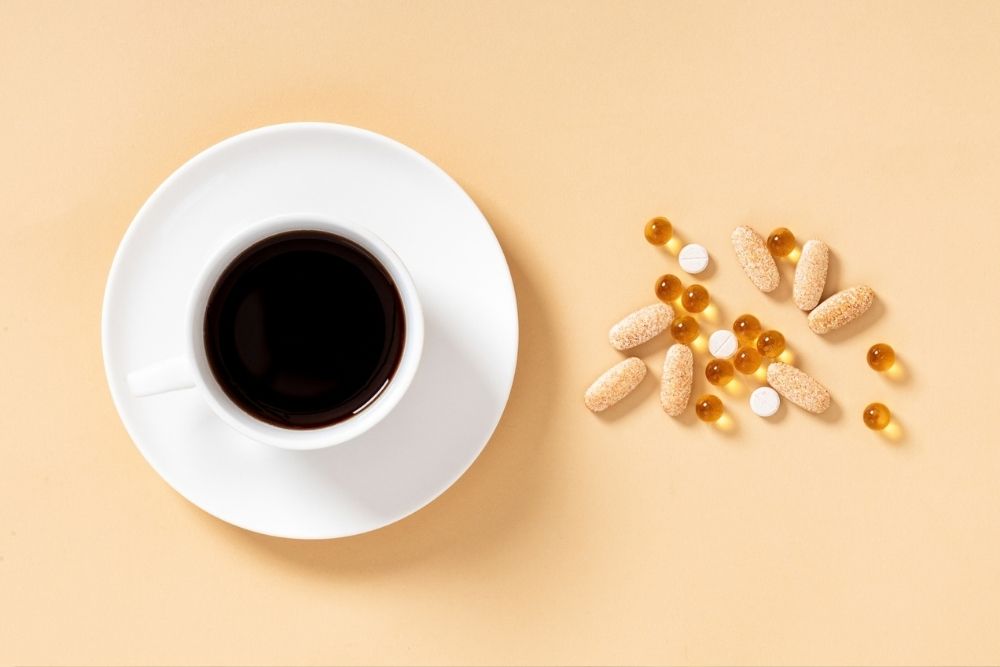
[IMAGE: A mug of coffee and a cup of black tea on a table beside a small dish of vitamin capsules and a breakfast plate | alt: does coffee affect vitamin absorption, coffee and tea next to morning vitamins]
Does Coffee Affect Vitamin Absorption? What the Research Shows
A reader once asked The People’s Pharmacy exactly this: should you avoid coffee when you take your vitamins? Their answer was that the medical literature doesn’t show coffee interfering with vitamin absorption in general, with a couple of notable exceptions, including tea and iron.
That lines up with what we see in the research. Most of the well-designed studies on coffee and tea focus on minerals, especially iron, because that is where the effect is large and measurable. For water-soluble vitamins like B and C, and fat-soluble vitamins like A, D, E, and K, there is no strong evidence that a normal cup of coffee changes absorption in a way that matters.
You will see claims online that caffeine “flushes out” B vitamins because it makes you pee more. It is a tidy theory, but we haven’t found solid evidence that moderate coffee drinking leaves people short on B vitamins. If someone tells you otherwise with great confidence, it is fair to ask for the study.
Iron: Where Timing Really Matters
Coffee and tea contain polyphenols, plant compounds that bind to non-heme iron (the type found in plant foods, fortified cereals, and most supplements) in your gut and make it harder to absorb. Heme iron from meat is much less affected.
The coffee study
A classic 1983 study in the American Journal of Clinical Nutrition measured this directly. When people drank coffee with a meal, iron absorption fell from 8.12% to 4.58%, a drop of roughly 44%. Drinking coffee one hour after the meal reduced absorption just as much.
Here is the useful part: coffee taken one hour before the meal had no significant effect. So if you like your coffee first thing and breakfast a bit later, you may already be timing it well.
Tea is an even stronger inhibitor
Tea fans, this one is for you. A 1999 study in the British Journal of Nutrition found that black tea reduced non-heme iron absorption from a meal by 79% to 94%. Herbal teas were not off the hook either: peppermint tea cut absorption by 84%, cocoa by 71%, and chamomile by 47%.
And if you were hoping a splash of milk would soften the effect, the researchers found that adding milk to coffee and tea had little or no influence.
Does It Matter in Real Life?
Lab studies of single meals don’t always translate into real-world deficiency. Your body adapts, and people who eat a varied diet with some meat often absorb enough iron regardless. Still, there are signs it can matter for some groups.
A 2023 study of 10,435 Japanese adults in Frontiers in Nutrition found that postmenopausal women who drank three or more cups of coffee a day had about twice the odds of iron deficiency (odds ratio 2.20) compared with women who drank almost none. There was no significant link in premenopausal women. This was an observational study, so it shows an association, not proof that coffee caused the deficiency.
The people most likely to feel the effect are those whose iron is already borderline:
- People taking an iron supplement for diagnosed deficiency
- Vegetarians and vegans, who rely entirely on non-heme iron
- Women with heavy periods and endurance athletes
- Anyone who drinks coffee or tea with every meal
A quick example
Picture two breakfasts. In the first, you have a bowl of iron-fortified cereal with a big mug of black tea. In the second, you drink your tea while you get ready, then eat the same cereal an hour later with a glass of orange juice. The food is identical, but based on the research above, the second version likely lets you absorb noticeably more of the iron in that bowl.
For someone eating steak a few nights a week, that difference may never show up on a blood test. For a vegetarian runner with low ferritin, small daily differences like this can add up over months.
If that sounds like you, our post on whether to take iron without a blood test explains why a ferritin check is a smart first step.
Calcium and Caffeine
You may also have heard that coffee is bad for your bones. The NIH Office of Dietary Supplements notes that caffeine reduces calcium absorption, but only to a small extent. For most people eating enough calcium, a few cups of coffee a day is unlikely to make a meaningful difference.
If you take a calcium supplement, the bigger factor is dose size. Calcium absorbs best in amounts of 500 mg or less at a time, so splitting a larger dose across meals matters more than moving it away from your latte.
A Simple Coffee and Vitamin Routine
You don’t need to give up your morning cup. A few small adjustments cover nearly everyone:
- Multivitamin without iron: Take it with breakfast, coffee and all. There is no good evidence that your mug is undoing it.
- Iron supplement: Keep coffee and tea at least an hour away from your iron dose, ideally before rather than after. Water or a glass of orange juice is a better companion.
- Iron-rich meals: If you rely on beans, lentils, spinach, or fortified cereal for iron, try having your coffee or tea between meals instead of with them.
- Thyroid medication: Coffee can interfere with thyroid medicine, so follow your pharmacist’s advice on spacing.
For the full picture on timing, including vitamin D and fat, see our guide to the best time to take your vitamins. And if your mornings are a blur of meetings and a commute, our page for busy professionals has more realistic routines.
This is one area where formulation helps. Because Vitamin100 contains no iron, the main coffee concern doesn’t apply to it. Take your two capsules with breakfast, and enjoy your coffee without doing math.
Frequently Asked Questions
How long after coffee should I take my vitamins?
For most multivitamins without iron, you don’t need to wait. If you take iron, the research suggests having coffee at least an hour before your iron dose or meal, since coffee with or an hour after the meal reduced absorption substantially.
Does coffee block B vitamins?
There is no strong evidence that normal coffee intake blocks B vitamin absorption. The concern mostly comes from the fact that coffee is a mild diuretic, but research hasn’t shown that this leaves coffee drinkers deficient.
Is tea worse than coffee for iron absorption?
In the studies we reviewed, black tea was a stronger inhibitor, cutting non-heme iron absorption by 79% to 94% compared with about 44% for coffee in a separate study. Some herbal teas, like peppermint, were also strong inhibitors.
Does adding milk to tea or coffee change anything?
Not much. The 1999 British Journal of Nutrition study found milk had little or no effect on how strongly coffee and tea inhibited iron absorption.
The Bottom Line
Your coffee is not sabotaging your multivitamin. The real interaction is with iron, where coffee and especially tea can make a big difference when they share a meal. If you take iron or rely on plant sources for it, give your mug a little space. Everyone else can pour another cup.
Sources
- Should You Avoid Coffee When You Take Your Vitamins?, The People’s Pharmacy, 2020
- Inhibition of food iron absorption by coffee, American Journal of Clinical Nutrition, 1983
- Inhibition of non-haem iron absorption in man by polyphenolic-containing beverages, British Journal of Nutrition, 1999
- Association between green tea and coffee consumption and body iron storage in Japanese men and women: a cross-sectional study from the J-MICC Study Saga, Frontiers in Nutrition, 2023
- Calcium: Fact Sheet for Health Professionals, NIH Office of Dietary Supplements, accessed 2026
These statements have not been evaluated by the Food and Drug Administration. This product is not intended to diagnose, treat, cure, or prevent any disease. This article is for general education and is not a substitute for advice from your healthcare provider.