
7 min read
Someone on Quora once asked a question that sounds simple: why don’t military rations just include a multivitamin? It is a fair question. Rations are engineered down to the calorie, and the people eating them are asked to march, lift, dig, and stay sharp on too little sleep. The real answer is more interesting than yes or no, and it says a lot about nutrition for military service members and the veterans they become.
Quick answer: the nutrients that matter most in military life tend to be specific rather than general. Iron deficiency is common in women entering service, bone stress injuries are a real training risk where calcium and vitamin D have been studied, and short sleep is widespread. A one-size-fits-all pill does not solve those, so targeted testing, food, and smart supplement choices work better.
Whether you are heading to basic, serving now, or years past your DD-214, here is what the research shows and what you can do with it.
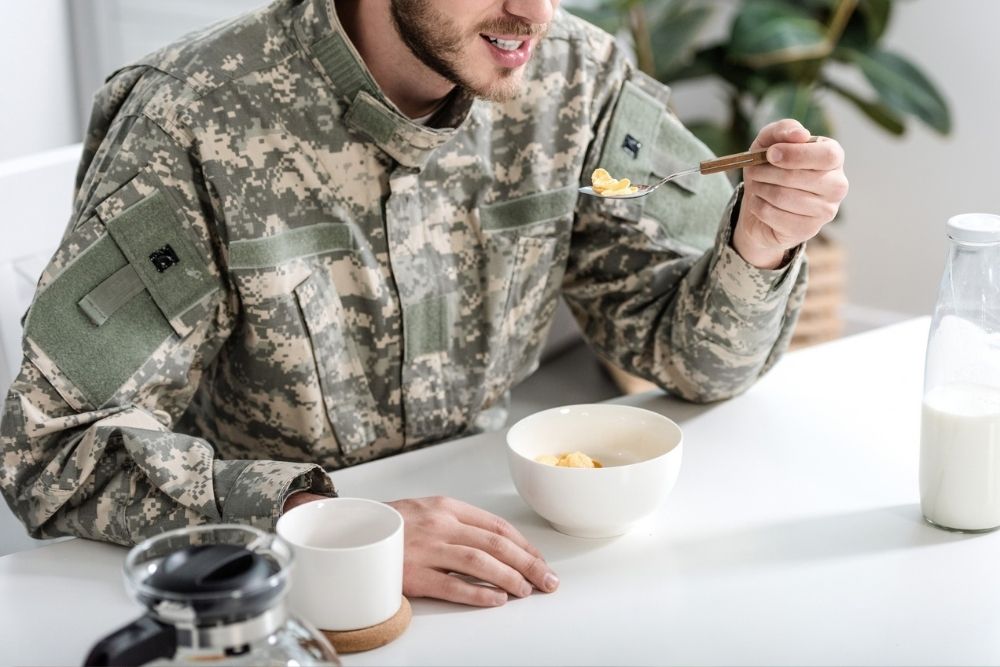
[IMAGE: Service member in training uniform eating a meal from a tray in a dining facility | alt: soldier eating a balanced meal, nutrition for military service members]
Iron: The Quiet Readiness Problem
Iron carries oxygen to working muscles, so running low shows up as fatigue, slower run times, and feeling winded doing things that used to be easy. In military training, where performance is measured constantly, that matters.
The numbers are striking. A recent meta-analysis in Military Medicine pooled 22 studies and found that before basic training, iron deficiency affected 26.7% of women compared with 13.0% of men. A 2016 Army report estimated that about 25% of women entering service were iron deficient and that the figure rose to a little over half by advanced individual training, which is why the Army began issuing female trainees a multivitamin with 27 mg of iron.
The research is not perfectly consistent on the “during training” part. The meta-analysis found that iron status did not seem to change much over basic training shorter than 16 weeks. Either way, a sizable share of women start service already low, and that is the number worth acting on.
Also notice what the Army’s response was: a targeted supplement for a group with a measured problem, not a blanket pill for everyone. Iron is a nutrient where more is not automatically better, and too much can cause harm. If you are fatigued, ask for a blood test that includes ferritin before starting iron on your own. Our guide on whether to take iron without a blood test explains what those numbers mean.
Bone Health and Stress Fractures
Few things derail a training pipeline like a stress fracture. They come from repetitive loading, often on legs that are not yet adapted to rucking and running on hard surfaces. Training design matters most, but nutrition has been studied too.
In a large randomized trial of 5,201 female Navy recruits, those who took 2,000 mg of calcium and 800 IU of vitamin D daily during basic training had 20% fewer stress fractures than those given a placebo (5.3% vs 6.6%). That is a meaningful result from a well-designed study. It is also one population in one setting, so it supports paying attention to calcium and vitamin D rather than proving that every recruit needs a supplement.
The practical takeaways: get calcium from dairy, fortified plant milks, canned salmon with bones, or leafy greens, and know your vitamin D status, especially if you train indoors or are stationed somewhere with long, dark winters. For the bigger picture on vitamin D, see our post on vitamin D for bone health, immunity, and recovery.
Sleep: The Nutrient You Cannot Buy
Sleep is not a vitamin, but no conversation about readiness makes sense without it. A RAND Corporation study found that only 37.4% of service members reported sleeping 7 or more hours, while 31.4% slept 5 hours or less. Duty schedules, deployments, and shift work all play a part.
Short sleep affects appetite, decision-making, mood, and recovery from hard training. It also changes how people eat: more caffeine, more quick sugar, fewer planned meals. You cannot supplement your way out of a 4-hour night, but you can protect what sleep you get: keep caffeine earlier in the day when you can, keep the sleep area dark and cool, and take a real meal before a long shift instead of grazing on vending machine snacks.
Nutrition for Military Service Members: What Supplement Use Looks Like
Service members take supplements at high rates. According to the American Society for Nutrition’s summary of a large survey, 74% of 26,681 active-duty members reported using dietary supplements weekly, and 45% used a multivitamin. Protein powders, pre-workouts, and energy products are common too.
That is where caution comes in. Some products, particularly pre-workouts and weight-loss or “muscle-building” formulas, have contained stimulants or ingredients that are prohibited for service members or unsafe. The Department of Defense runs Operation Supplement Safety (OPSS), a free resource with a list of prohibited ingredients and guidance on checking a product before you take it. It is worth bookmarking, whether you are on active duty or not.
A few ground rules that serve anyone well:
- Prefer products that list every ingredient and amount, with no proprietary blends.
- Be skeptical of anything promising dramatic muscle gain, fat loss, or energy.
- Look for third-party testing, and check ingredients against the OPSS resources if you are subject to military drug testing.
- Tell your medical team what you take, including “natural” products.
Heat, Hydration, and Field Conditions
Long days outdoors in heavy gear raise fluid and sodium needs fast. Follow unit guidance on water intake, and remember that overdrinking on long efforts carries risk too. Our summer hydration guide on water versus electrolytes walks through how to estimate your sweat rate and when an electrolyte drink makes sense.
For Veterans: Carrying the Good Habits Forward
Leaving service often means leaving the structure that shaped your eating, training, and sleep. The dining facility is gone, the PT schedule is gone, and for many veterans the activity level drops while appetite stays the same. Some carry sleep habits from years of shift work and deployments into civilian life.
The fundamentals do not change, though:
- Keep lifting and moving. Muscle and bone respond to training at any age.
- Know your numbers. A checkup with bloodwork, including vitamin D and iron studies if relevant, gives you a baseline.
- Eat for the activity you do now. Protein with each meal, plenty of vegetables and fruit, and fewer ration-style convenience foods.
- Treat sleep as a health issue. If sleep problems persist, bring them up with your VA or civilian provider. They are common and treatable.
If you do want a daily multivitamin as a backstop, consider how iron fits. Vitamin Armor’s Vitamin100 multivitamin was designed by an internal medicine physician to provide 100% of the Daily Value of its nutrients and leaves iron out on purpose, so iron can be dosed individually based on bloodwork. That approach mirrors what the Army did: target iron to the people who actually need it.
Frequently Asked Questions
Why don’t military rations include multivitamins?
We could not find a single official answer, but the pattern in the research is telling. When the military has found a specific, measured problem, it has tended to respond with a targeted fix, like the Army’s iron-containing multivitamin for female trainees, rather than a pill for everyone.
Are women in basic training more likely to be iron deficient?
Yes. A recent meta-analysis found iron deficiency in 26.7% of women versus 13.0% of men before basic training, and a 2016 Army estimate suggested it can rise during training. A ferritin test is the best way to know where you stand.
Do calcium and vitamin D prevent stress fractures?
In one large trial of female Navy recruits, calcium plus vitamin D reduced stress fractures by 20%. That is encouraging, but it is one study, and training load and recovery still matter most. Talk with your medical team about your own risk.
How can I check if a supplement is safe for military use?
Operation Supplement Safety, run by the Department of Defense, offers a prohibited ingredient list and tips for evaluating products. It does not endorse brands, so use it as a screening tool alongside advice from your medical team.
The Bottom Line
Service members do not need a magic pill. They need enough iron (confirmed by testing), steady calcium and vitamin D for bones under heavy load, as much sleep as the mission allows, and a skeptical eye for flashy supplements. Those habits keep paying off long after the uniform comes off.
Sources
- Systematic Review and Meta-Analysis: Iron Deficiency and Iron Deficiency Anemia Among Military Recruits Undergoing Basic Combat Training, Carrasco et al., Military Medicine, 2025
- Female trainees to receive iron supplements, U.S. Army (army.mil), 2016
- Calcium and Vitamin D Supplementation Decreases Incidence of Stress Fractures in Female Navy Recruits, Lappe et al., Journal of Bone and Mineral Research, 2008
- Sleep Problems and Their Impact on U.S. Servicemembers: Results of a Cross-Service Survey, RAND Corporation, 2015
- Dietary supplement use among active-duty military service members, American Society for Nutrition, 2021
- Operation Supplement Safety (OPSS), U.S. Department of Defense, Uniformed Services University, 2026
These statements have not been evaluated by the Food and Drug Administration. This product is not intended to diagnose, treat, cure, or prevent any disease. This article is for general education and is not a substitute for advice from your healthcare provider.